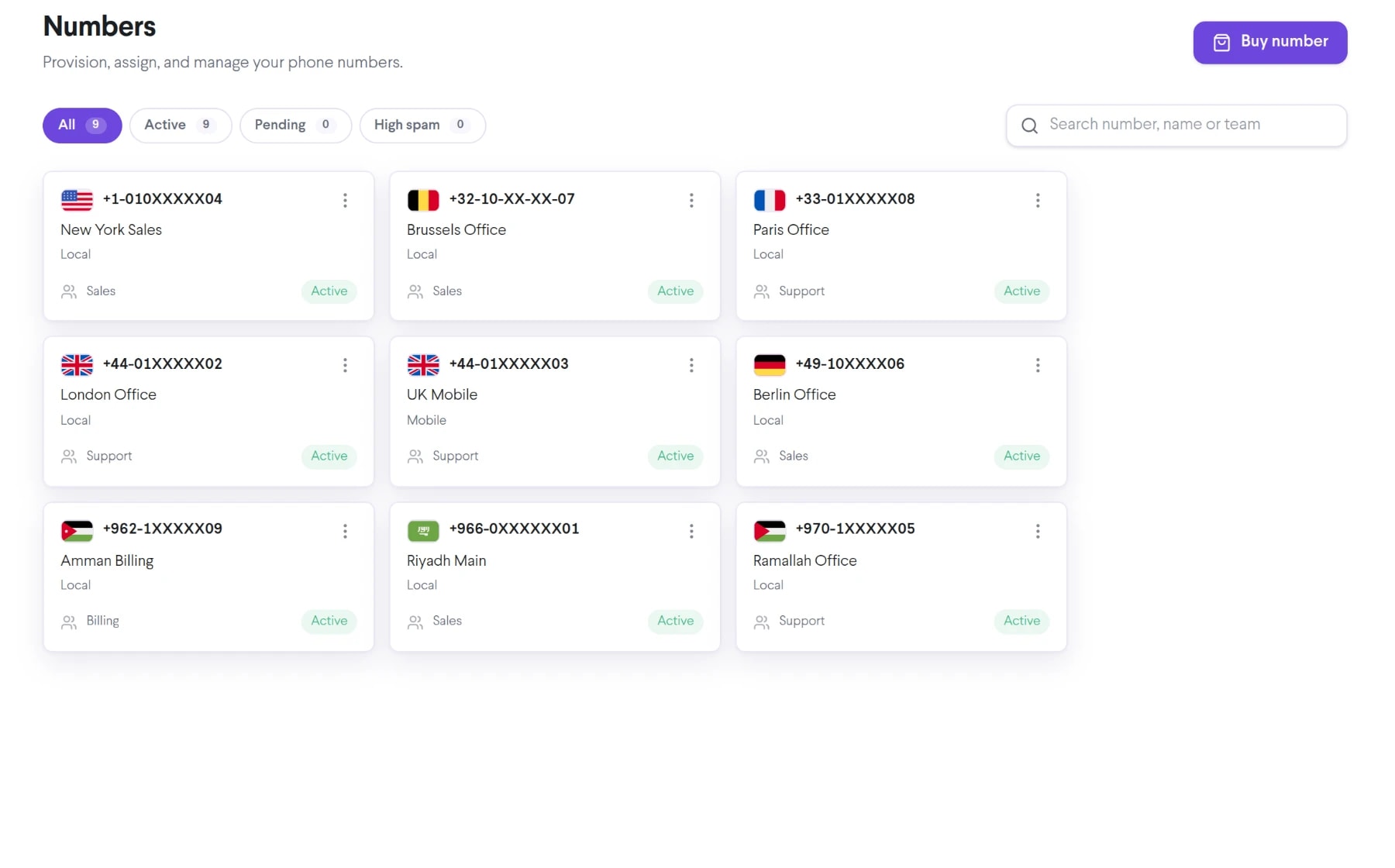
Local numbers across your markets. One team behind them.
Give travellers a local number in each market, route by time zone to the right desk, and use AI to read calls in English, Arabic, Italian, French and Spanish and spot travellers who keep calling back.
7-day free trial · no card · usually verified within 1 business day · onboarding call · then set up with a number in about 2 minutes
- Numbers in 90+ countries
- Routing by market and time zone
- Trip reminder campaigns
- Repeat callers during disruption
Trusted by 1,000+ companies






Travellers call from everywhere, at every hour.
International numbers are a mess
Each market has its own provider, and calls cannot be routed between offices.
Disruption floods the line
A cancelled flight means dozens of travellers calling back again and again.
Reminder calls take a whole team
Departure times, documents and payment reminders are dialled by hand.
What a travel team runs on TalkChief.
Shipped features, shown with fictional demo data.
Route each market by its own hours.
Every local number gets a call flow with working hours, an IVR menu and queues. When the Riyadh desk closes, calls can roll to another office or an AI agent instead of ringing out.
- Working hours per market
- IVR menu and queues
- Failover between offices

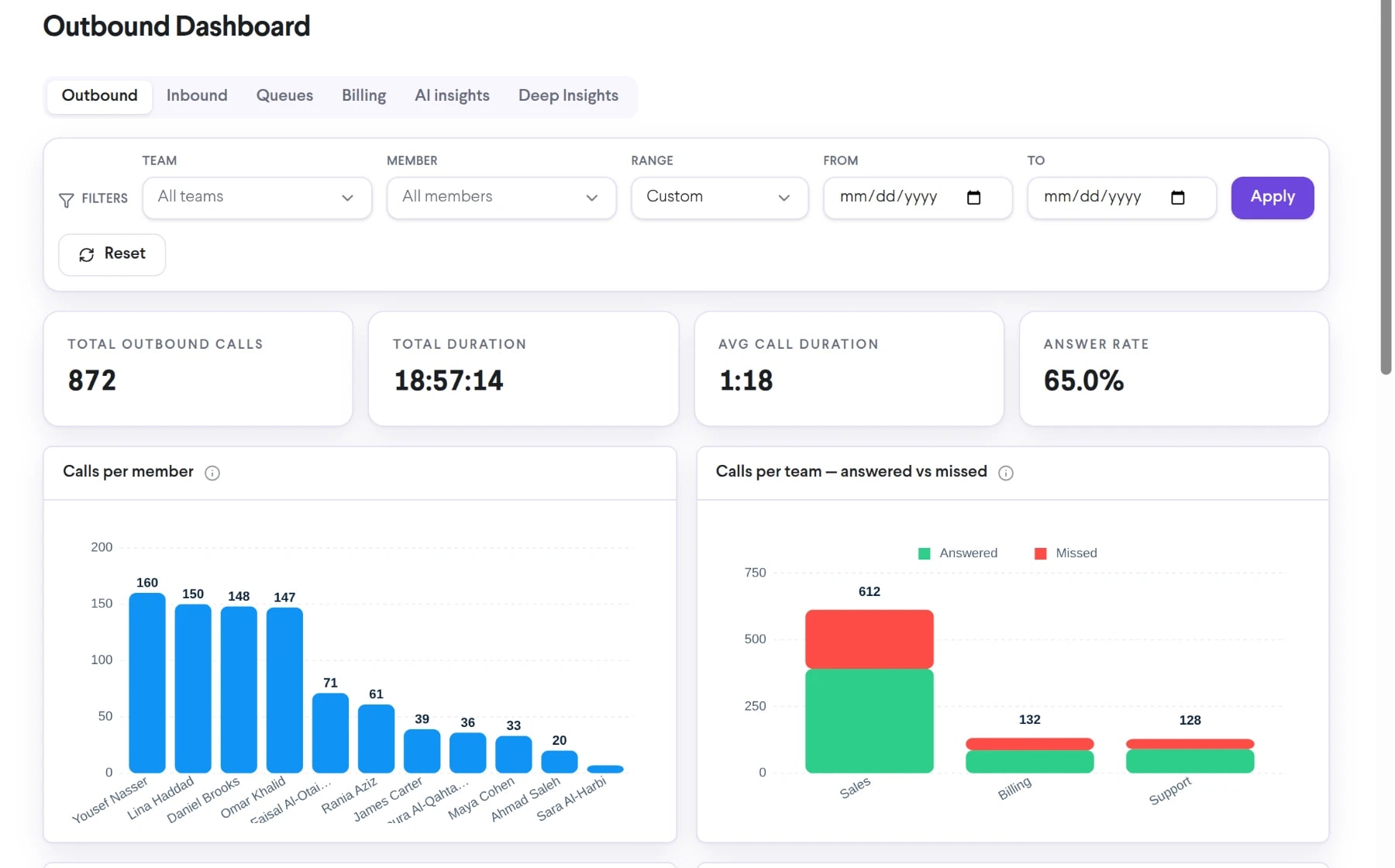
Reminder calls made by an AI agent.
An AI voice agent calls your list inside the calling window you set, in Arabic dialects or English, confirms or reschedules, retries the ones who did not answer and checks the do-not-call list before every dial.
- Calling window, timezone and retries
- Do-not-call check before every dial
- Transfer to a person when asked
AI Voice Agents: $0.15 per connected minute, or the usage-based cost of the call if that is higher, charged from your wallet. A call starts only when the wallet holds at least $10.
See outbound campaigns
Review traveller calls in English, Arabic, Italian, French and Spanish.
With AI Call Intelligence on, recorded calls are transcribed in English, Arabic, Italian, French and Spanish, with speakers separated and a summary, reason and outcome on each call.
- Transcripts with speakers separated
- A summary, reason and outcome per analysed call
- Search calls by meaning
AI Call Intelligence add-on on Growth and Professional: $10 per member per month, 1,500 minutes per member included, then $0.01 per minute.
See AI Call Intelligence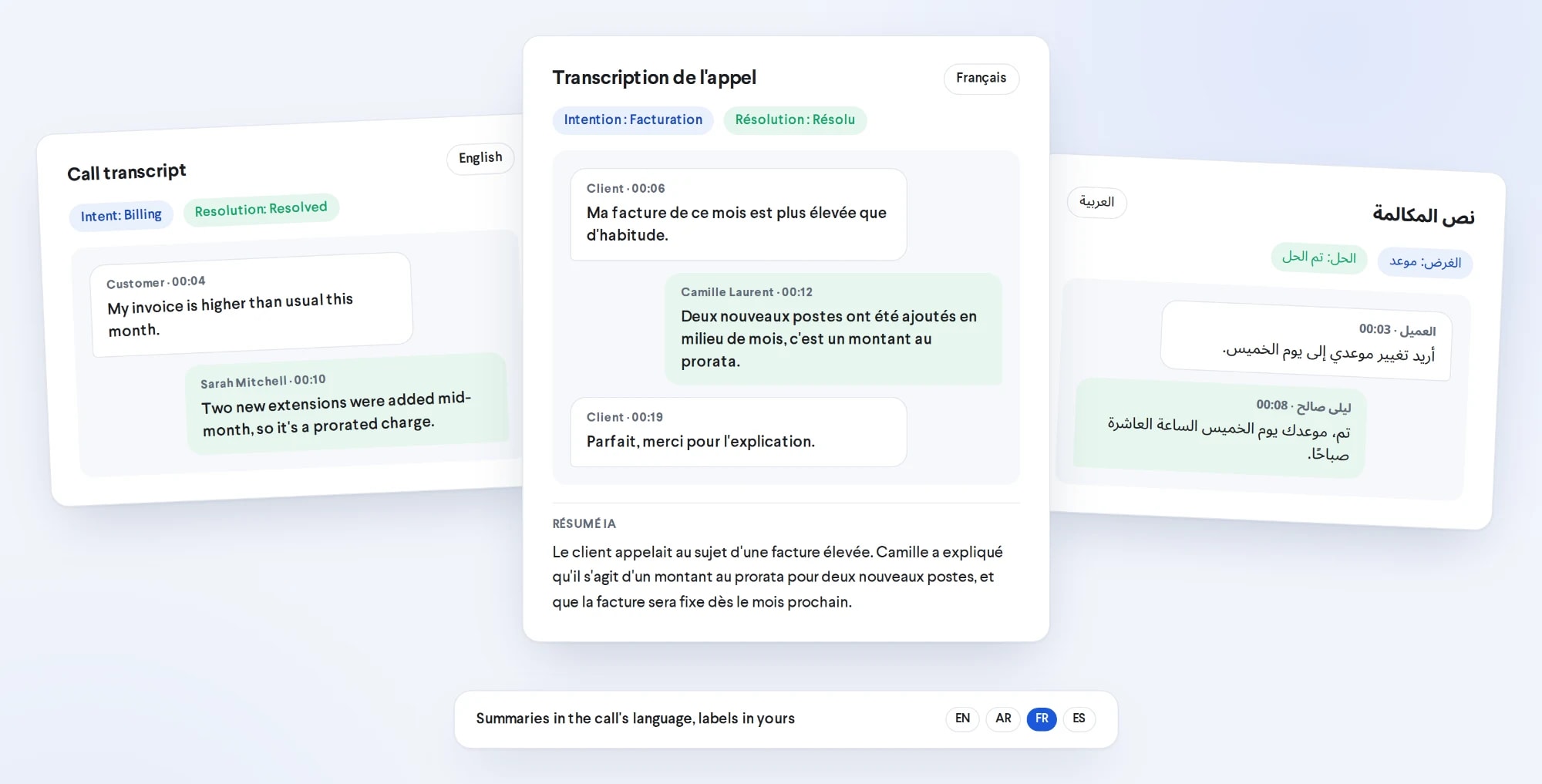
Spot the travellers who keep calling back.
Deep Insights lists customers with two or more calls in the period and what they keep raising, so a supervisor can own the case during a disruption.
- Repeat callers ranked by calls
- The issues each one raises
- Open the calls in one click
AI Call Intelligence add-on on Growth and Professional: $10 per member per month, 1,500 minutes per member included, then $0.01 per minute.
See Deep Insights
How a traveller call moves through TalkChief.
- 01
Local number in the market
The traveller calls a number in their own country.
- 02
Market hours decide
Open: the local desk. Closed: another office or an AI agent.
- 03
Desk queue answers
Agents answer by skill and order, from any office or the app.
- 04
AI flags the follow-up
With AI Call Intelligence on, repeat callers and escalations surface for the supervisor.
What we protect, and what stays your call.
Security on every plan
- AES-256 encryption at rest and TLS in transit
- Call recordings and files encrypted in object storage
- Encrypted, access-controlled databases
- Roles for admins, supervisors and agents; supervisors see only their teams
Numbers depend on the market
Numbers are available in 90+ countries, but number type, documents and inbound and outbound rights vary by country and are confirmed before purchase.
You decide what is recorded and analysed
Call recording is on Growth (kept 1 year) and Professional (kept 2 years). AI transcription is switched on for the company, a team or a member, for the call types you pick; internal calls are never transcribed. Tell callers about recording and transcription as your local rules require.
Official references: Data Protection & Privacy (International Air Transport Association) · Facilitation and Passenger Data (International Air Transport Association) · Travel and Tourism Services Regulations service guide (Saudi Ministry of Tourism) · Guide to the Saudi Personal Data Protection Law (Saudi Data & AI Authority)
TalkChief for travel: common questions.
Plans: Essential $8, Growth $13, Professional $17 per member per month, billed annually.
Compare plansCan TalkChief give us numbers in several countries?
Yes. Numbers are available in 90+ countries; availability, number type and required documents vary by market and are confirmed for each country.
Can calls be routed by time zone?
Yes. Each number has its own call flow with working hours, so a market can route to its local desk during the day and to another office, an AI agent or voicemail when that desk is closed.
Can an AI agent make reminder calls?
Yes. AI outbound campaigns call a list inside the calling window and timezone you set, with retries and a do-not-call check before every dial. AI Voice Agents cost $0.15 per connected minute, or the usage-based cost of the call if that is higher, from your wallet.
Can TalkChief change an airline booking?
No. TalkChief is the communications layer. The AI agent can call your own API or MCP tools if you connect them; booking changes stay in your booking system.
Can it connect to a GDS or booking platform?
There is no prebuilt GDS connector. Use the AI agent’s API or MCP tools, completed-call webhooks or a scoped integration.