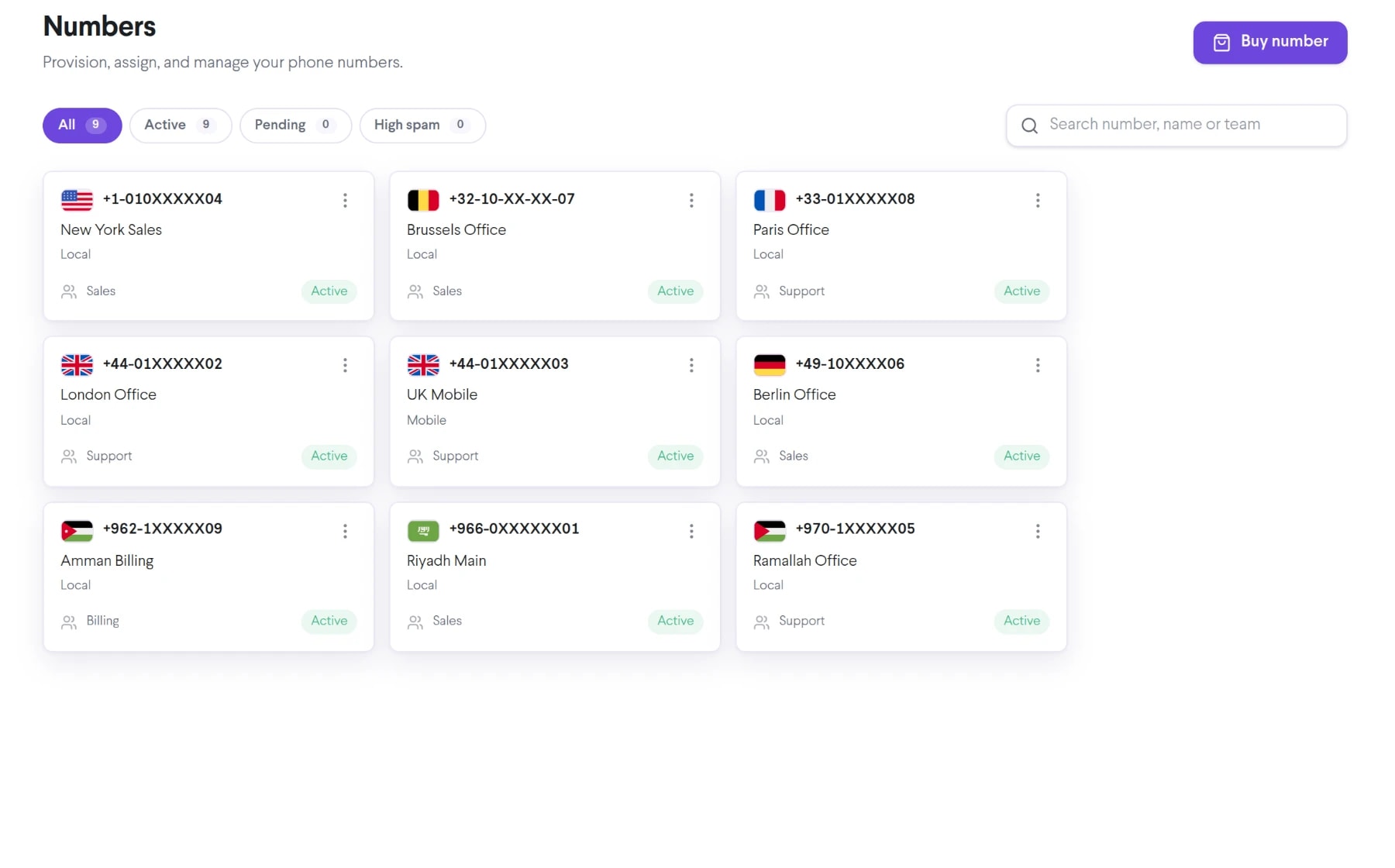
Guests call at 3 a.m. An AI front desk picks up, in Arabic too.
Route reservations and every property from one call flow, let an AI front desk answer after hours, and keep central and property teams in one Cowork workspace on the Professional plan.
7-day free trial · no card · usually verified within 1 business day · onboarding call · then set up with a number in about 2 minutes
- AI front desk 24/7 after hours
- Call flows per property
- English, Arabic, Italian, French and Spanish transcripts
- Cowork for property teams

Trusted by 1,000+ companies






A ringing reservations line is lost revenue.
Night calls go nowhere
Guests call after hours about bookings and late arrivals. The phone rings out or lands in a voicemail nobody checks.
Central and property drift apart
Reservations takes the call, the property has to act, and the request falls between them.
Guests speak many languages
Managers cannot review calls they do not understand, so service problems stay hidden.
What a hotel group runs on TalkChief.
Shipped features, shown with fictional demo data.
An AI agent answers when the desk cannot.
An AI voice agent picks up after hours or when every line is busy. It answers from your property FAQ, uses Google Calendar or your own API, and transfers to the duty manager when a guest asks for a person.
- Gulf Arabic, other Arabic dialects and English
- Answers from your own documents
- Transfer to a person when asked
AI Voice Agents: $0.15 per connected minute, or the usage-based cost of the call if that is higher, charged from your wallet. A call starts only when the wallet holds at least $10.
See AI Voice Agents
Review guest calls in English, Arabic, Italian, French and Spanish.
With AI Call Intelligence on, recorded calls are transcribed in English, Arabic, Italian, French and Spanish with speakers separated, and summarised with the reason and outcome, so managers review service without listening to hours of audio.
- Transcripts with speakers separated
- A summary, reason and outcome per analysed call
- Calls that switch language mid-conversation
AI Call Intelligence add-on on Growth and Professional: $10 per member per month, 1,500 minutes per member included, then $0.01 per minute.
See AI Call Intelligence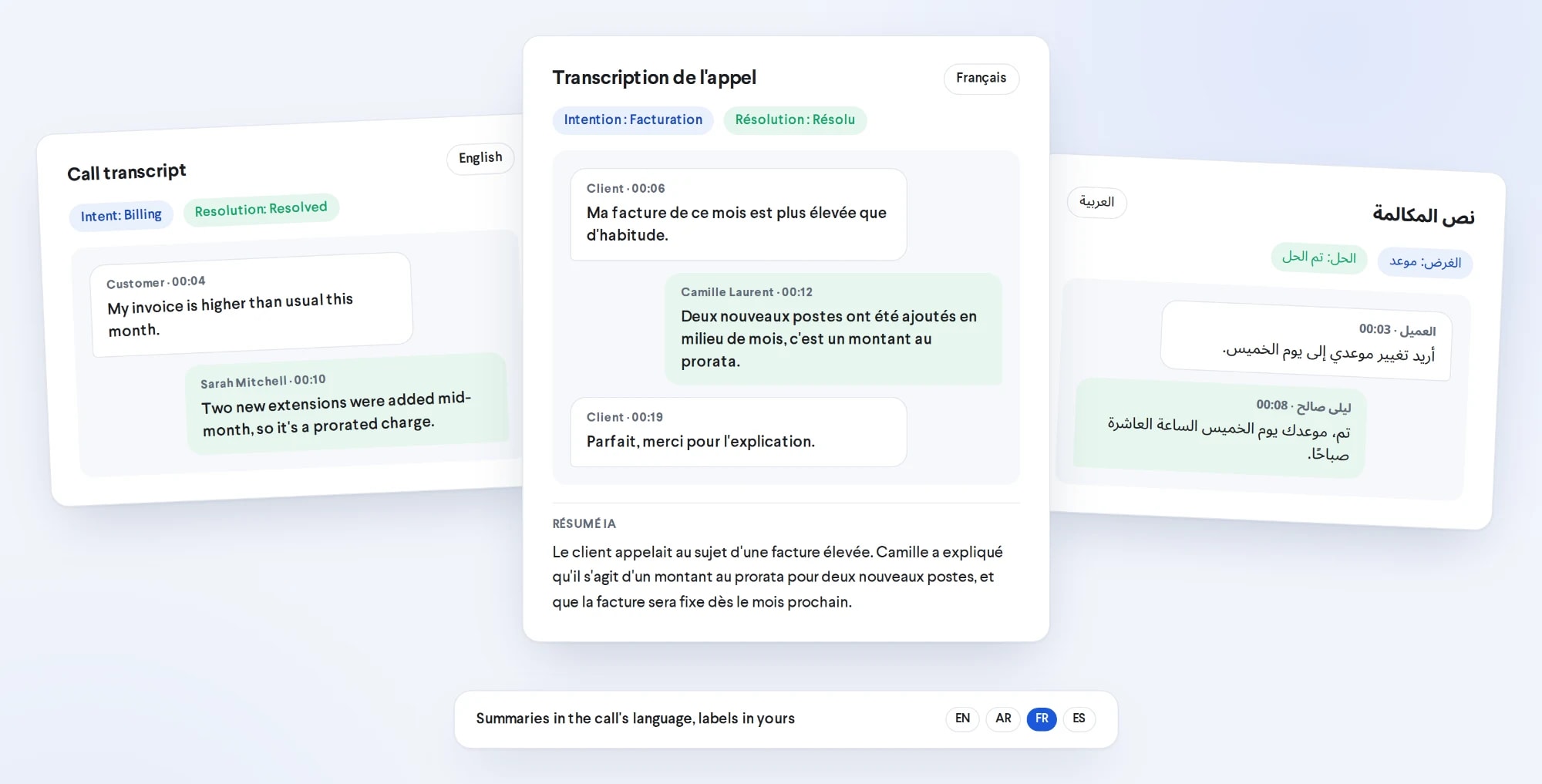
Reservations and property teams in one workspace.
Channels per property, direct messages, threads and meetings with screen sharing, with the business phone dialer built in. AI escalation alerts can post into the property channel so the duty manager sees them.
- Web, Windows, macOS, iOS and Android
- Group calls with screen sharing
- Escalation alerts in a channel (needs AI Call Intelligence)
Cowork is included in the Professional plan.
See Cowork
Coach the reservations agent while the guest is on the line.
Supervisors open Live Calls and pick a call: Listen silently, Coach the agent without the guest hearing, or Join the conversation. Queue health sits beside it: who is waiting and for how long.
- Listen, Coach and Join
- Queues right now: waiting and longest wait
- Queue dashboard with service level
Live Calls with Listen, Coach and Join are on the Professional plan.
See live call monitoring
How a guest call moves through TalkChief.
- 01
Guest calls a property
Working hours pick the route for that property.
- 02
Desk or AI front desk
Open: reservations and front desk queues. Closed: the AI agent answers.
- 03
Handover to a person
The AI agent transfers to the duty manager when asked.
- 04
Team sees the follow-up
Escalations post to the property channel in Cowork.
What we protect, and what stays your call.
Security on every plan
- AES-256 encryption at rest and TLS in transit
- Call recordings and files encrypted in object storage
- Encrypted, access-controlled databases
- Roles for admins, supervisors and agents; supervisors see only their teams
Guest data stays your decision
You choose which calls are recorded and transcribed and who can open them. TalkChief does not claim any hospitality or privacy certification; check local tourism and data rules for each property.
You decide what is recorded and analysed
Call recording is on Growth (kept 1 year) and Professional (kept 2 years). AI transcription is switched on for the company, a team or a member, for the call types you pick; internal calls are never transcribed. Tell callers about recording and transcription as your local rules require.
Official references: Tourism Accommodation Facility Regulations service guide (Saudi Ministry of Tourism) · Guide to the Saudi Personal Data Protection Law (Saudi Data & AI Authority)
TalkChief for hospitality: common questions.
Plans: Essential $8, Growth $13, Professional $17 per member per month, billed annually.
Compare plansCan TalkChief connect central reservations and individual hotels?
Yes. Give each property its own number and call flow, route to central reservations or the property front desk by working hours and IVR choice, and keep both teams in Cowork channels.
Can an AI agent answer guest calls at night?
Yes. Put an AI voice agent in the after-hours branch of your call flow. It answers from your documents, can use Google Calendar or your API, and transfers to a person when asked. AI Voice Agents cost $0.15 per connected minute, or the usage-based cost of the call if that is higher, from your wallet.
Can TalkChief integrate with a PMS?
There is no prebuilt PMS connector. The AI agent can call your own API or MCP tools, and completed-call webhooks and the Click-to-Call API are available; a PMS integration is scoped project work.
Can calls be handled in Arabic and English?
Yes. AI voice agents speak Arabic dialects and English, and AI Call Intelligence transcribes recorded calls in English, Arabic, Italian, French and Spanish, including calls that switch language mid-conversation.
Which plan do we need?
Call recording starts on Growth, Live Calls with Listen, Coach and Join and Cowork are on Professional. AI Call Intelligence is a $10 per member per month add-on on Growth and Professional.