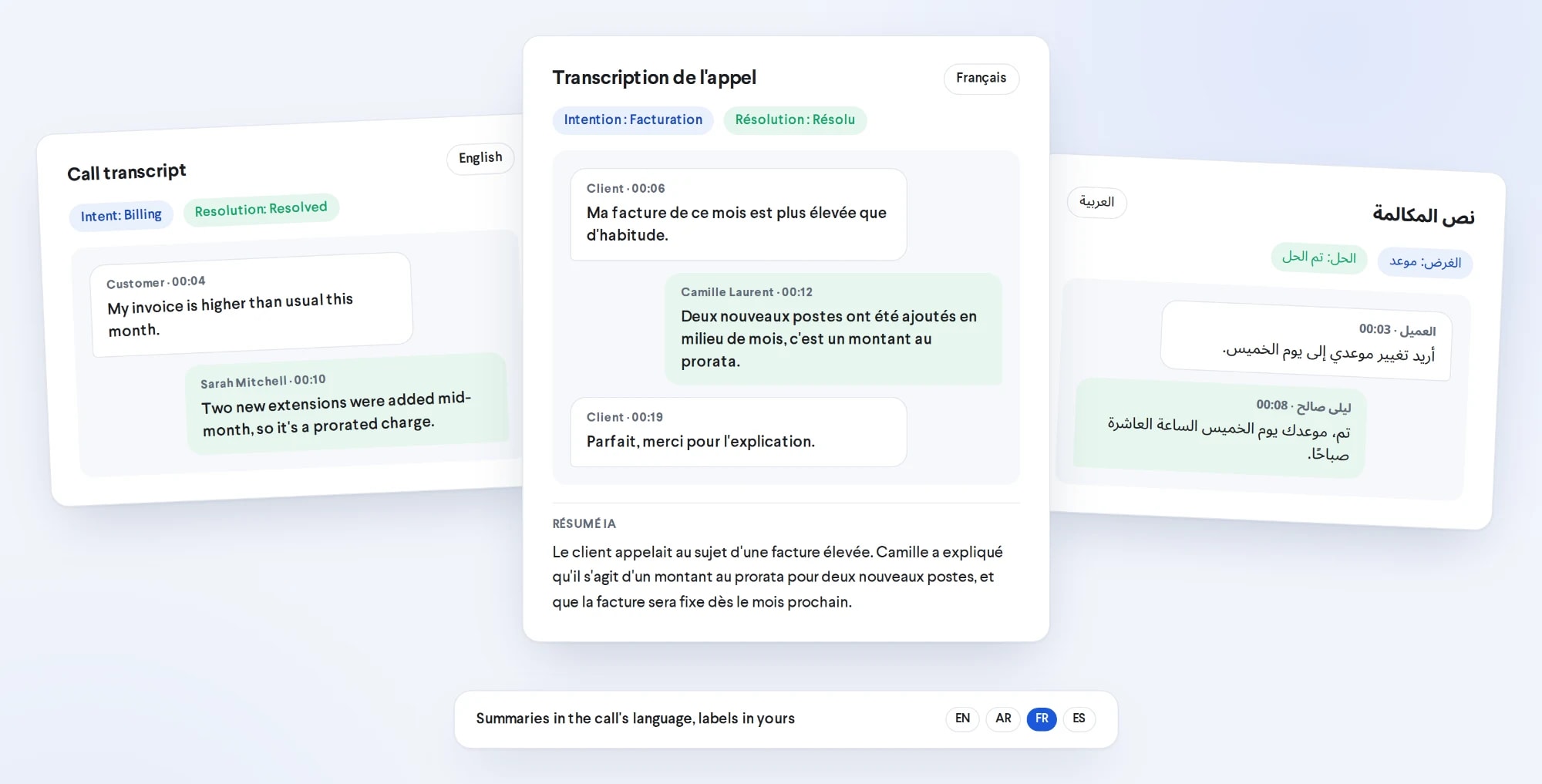
Hear the complaint, the threat, the churn signal, without listening to every call.
With AI Call Intelligence on, recorded calls in the teams and call types you choose are checked for complaints, legal threats and cancellation risk; internal and very short calls are skipped. Write your own rules, search calls by meaning and see which competitors customers mention.
7-day free trial · no card · usually verified within 1 business day · onboarding call · then set up with a number in about 2 minutes
- AI escalations with the exact line
- Custom rules in plain words
- Search calls by meaning
- Competitor and churn signals

Trusted by 1,000+ companies






One badly handled call can become a formal complaint.
Complaints hide in volume
Thousands of calls a week, and QA samples a handful. The legal threat is on the call nobody reviewed.
Your own risk phrases
Every institution has phrases it must catch. Generic keyword spotting misses how people actually speak.
Churn shows up as a closure
Customers mention a competitor or a cancellation weeks before they move their money.
What a financial-services team runs on TalkChief.
Shipped features, shown with fictional demo data.
Define what counts as an escalation for you.
Write rules in plain words, choose the severity and who must say it, and test each rule on recent calls before it goes live. Your rules are added to TalkChief’s standard detection.
- Severity: High, Medium or Low
- Said by the customer or the member
- Versioned and tested on recent calls
AI Call Intelligence add-on on Growth and Professional: $10 per member per month, 1,500 minutes per member included, then $0.01 per minute.
See AI escalations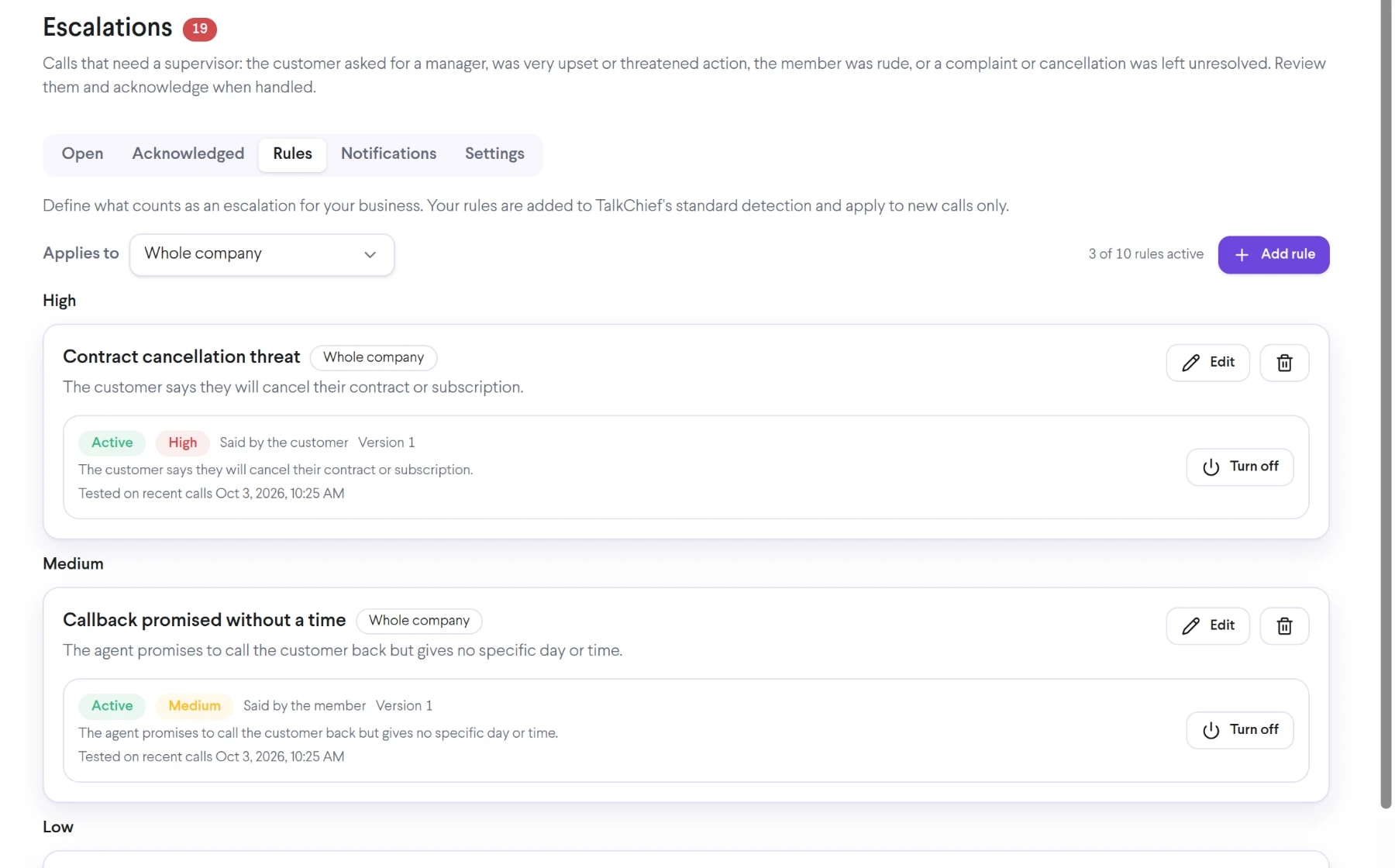
Find the calls about a disputed charge.
Search transcribed calls by meaning: “customer wants a refund” also finds “charged twice” and “money back”, in English, Arabic, Italian, French and Spanish. Filter by team, member and who said it.
- Exact words first, then similar meaning
- Filter by date, team, member and speaker
- Open the transcript and summary
AI Call Intelligence add-on on Growth and Professional: $10 per member per month, 1,500 minutes per member included, then $0.01 per minute.
See call search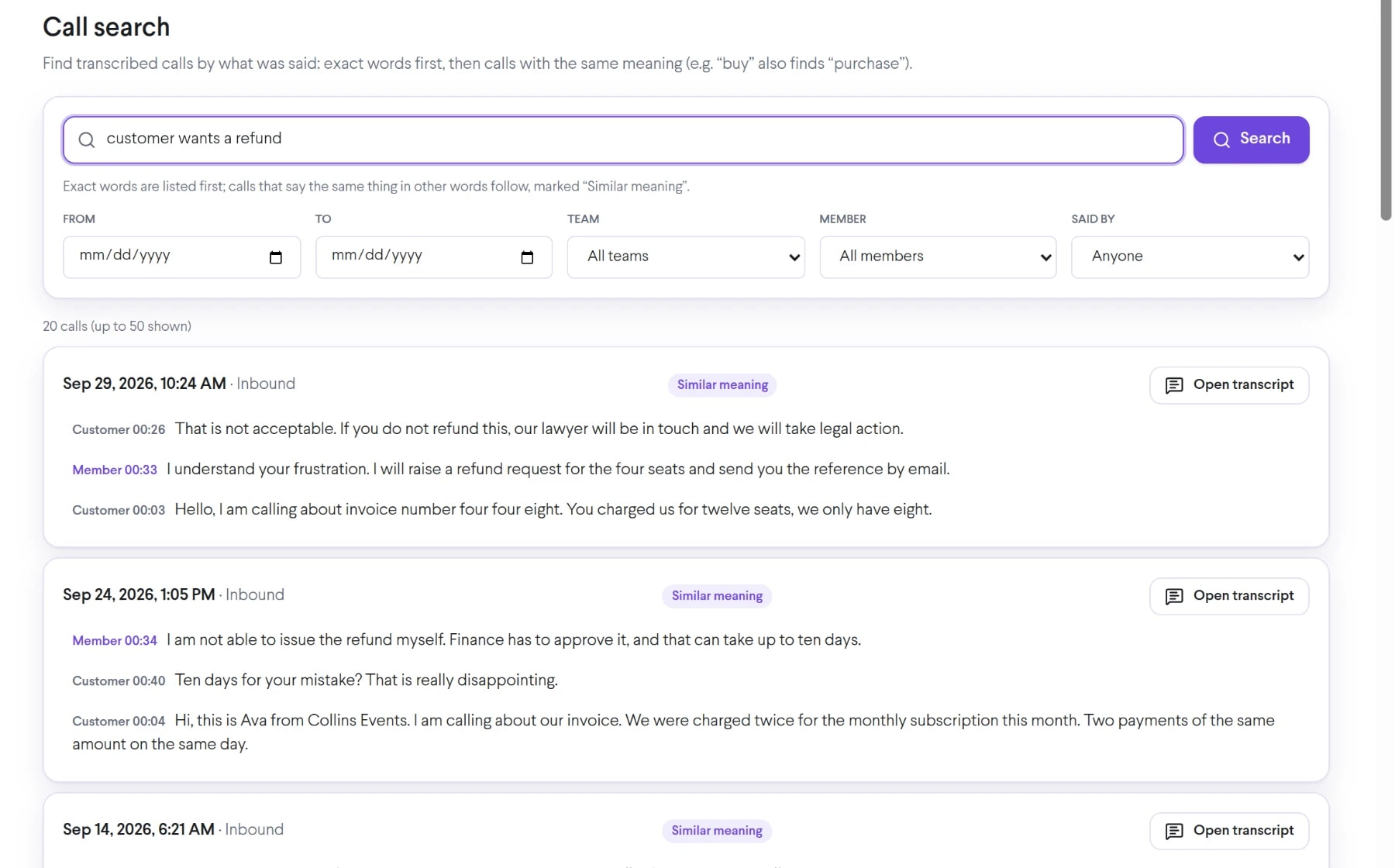
See which competitors are pulling customers away.
Deep Insights counts the calls that mention each competitor and the share flagged as churn risk, with the customer’s own words.
- Competitor mentions per period
- Share flagged as churn risk
- Repeat callers and their issues
AI Call Intelligence add-on on Growth and Professional: $10 per member per month, 1,500 minutes per member included, then $0.01 per minute.
See Deep Insights
Sentiment, resolution and complaint rate on one screen.
The AI insights dashboard tracks customer sentiment, resolution rate, escalation rate, complaint rate, churn-risk calls and member talk share against the previous period.
- Trends versus the previous period
- Open escalations waiting for a supervisor
- Filter by team and member
AI Call Intelligence add-on on Growth and Professional: $10 per member per month, 1,500 minutes per member included, then $0.01 per minute.
See the AI insights dashboard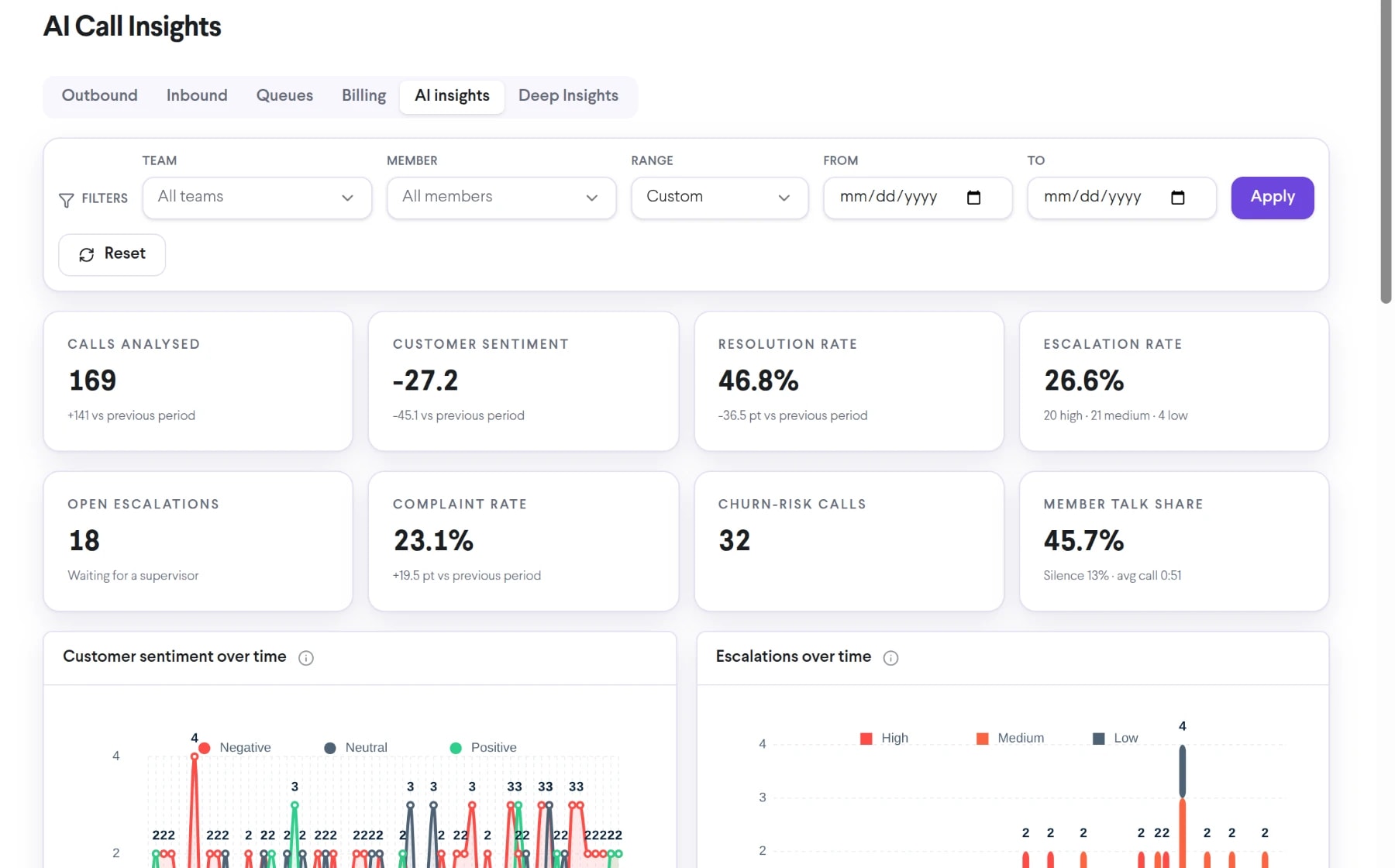
How a customer call moves through TalkChief.
- 01
Service line rings
Products and intents each get their own IVR path.
- 02
Specialist queue
Cards, lending or claims agents answer by skill and order.
- 03
AI reads the call
With AI Call Intelligence on: transcript, summary, sentiment.
- 04
Escalation to a supervisor
Standard and custom rules flag the call with the exact line.
What we protect, and what stays your call.
Security on every plan
- AES-256 encryption at rest and TLS in transit
- Call recordings and files encrypted in object storage
- Encrypted, access-controlled databases
- Roles for admins, supervisors and agents; supervisors see only their teams
No SAMA, PCI or ISO certification is claimed
TalkChief does not claim SAMA, PCI DSS, ISO or SOC 2 certification. Regulated entities assess the service against their own requirements.
Keep secrets off calls
Do not take card numbers, PINs or passwords over recorded or transcribed calls. Data is encrypted with AES-256 at rest and TLS in transit, in encrypted, access-controlled databases.
You decide what is recorded and analysed
Call recording is on Growth (kept 1 year) and Professional (kept 2 years). AI transcription is switched on for the company, a team or a member, for the call types you pick; internal calls are never transcribed. Tell callers about recording and transcription as your local rules require.
Official references: Cyber Security Framework (Saudi Central Bank) · PCI DSS document library (PCI Security Standards Council) · Guide to the Saudi Personal Data Protection Law (Saudi Data & AI Authority)
TalkChief for finance: common questions.
Plans: Essential $8, Growth $13, Professional $17 per member per month, billed annually.
Compare plansIs TalkChief SAMA compliant?
TalkChief does not claim SAMA, PCI DSS, ISO or SOC 2 certification. A regulated entity must assess the exact service, controls and contract against its own requirements.
What does AI flag as an escalation?
With AI Call Intelligence on, recorded calls are checked for a customer asking for a manager, being very upset or threatening action, a rude member, and complaints or cancellations left unresolved, plus any custom rules you write. Each escalation shows the severity, reason and quoted line.
Can customers provide card details on a call?
Do not treat ordinary calls, recordings or transcripts as an approved card-data channel. Define the permitted payment process with your payment-security and compliance stakeholders.
Can TalkChief make credit or fraud decisions?
No. TalkChief is a communications platform, not a credit, fraud or ledger system. Those decisions stay in your authorised systems.
How is call data protected?
AES-256 encryption at rest and TLS in transit; recordings and files are encrypted in object storage, and databases are encrypted and access-controlled. Roles limit supervisors to their own teams.